
America’s Religious Comeback Is Missing in Action
The latest data suggest Americans aren't rushing back to church

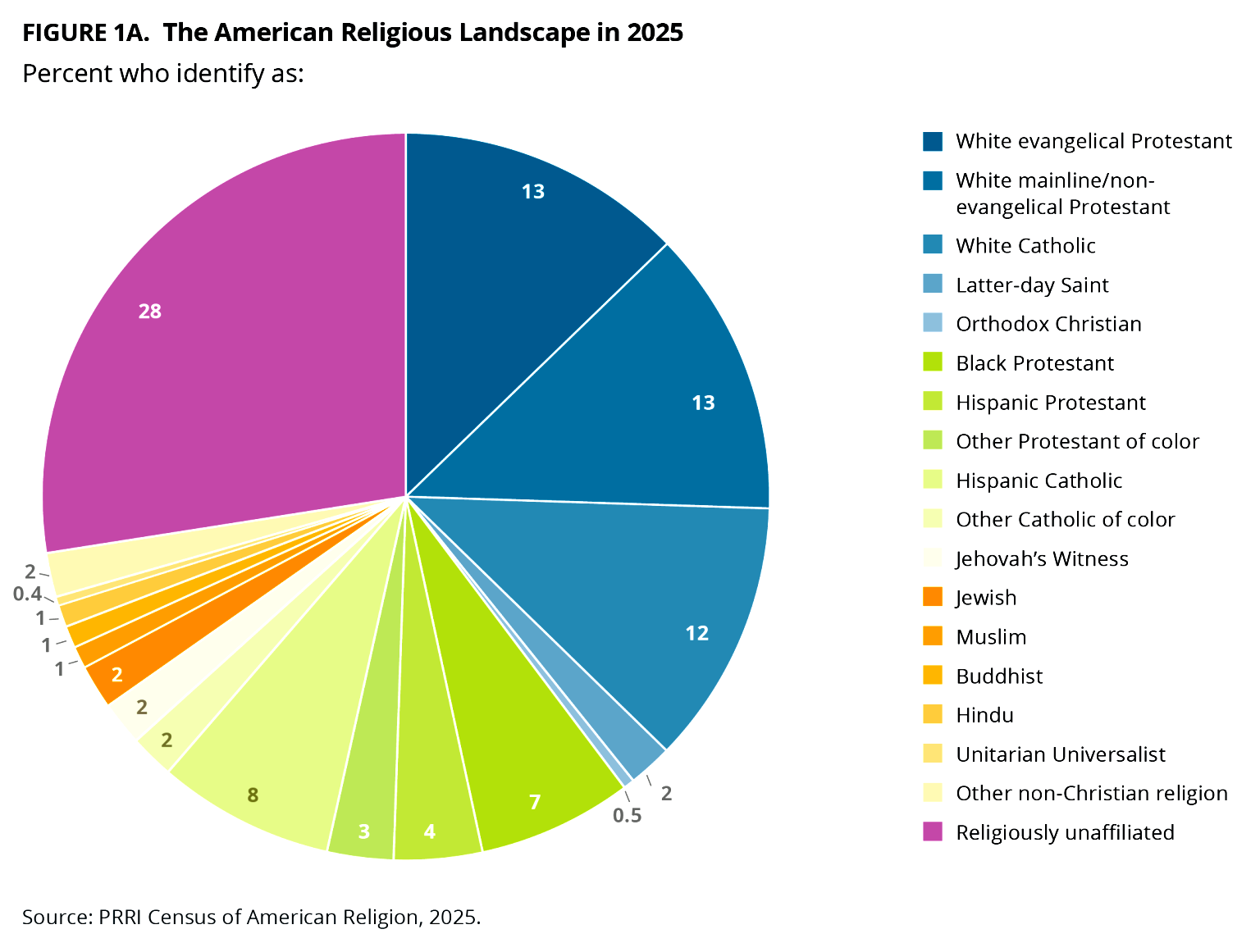
For years, religious commentators have been predicting a great American religious comeback. The story usually goes something like this: people are tired of secularism, churches are filling up again, and the nation is rediscovering faith.
Well, according to the 2025 PRRI Census of American Religion, that revival appears to be hiding in the same place as Bigfoot, Atlantis, and convincing evidence for miracle claims.
The survey found that America’s religious landscape barely changes. About 66% of Americans identify as Christian, 28% identify as religiously unaffiliated, and 6% belong to non-Christian religions.
One thing that definitely isn’t happening is a mass return to church. Weekly church attendance has fallen from 31% in 2013 to 26% in 2025. Meanwhile, the percentage of Americans who seldom or never attend religious services has climbed from 42% to 53%. Apparently, more people are deciding that sleeping in on Sunday is preferable to listening to a lecture about what an invisible cosmic authority wants them to do.
The rise of the religiously unaffiliated – atheists, agnostics, and people who simply shrug when asked about religion – has been one of the biggest stories of the past decade. Their share grew from 21% in 2013 to 28% in 2025. Growth has slowed recently, but there is no sign of a religious rebound.
Age remains one of the biggest predictors of religious belief. Among Americans aged 18–29, only 54% identify as Christian, compared with 76% of those aged 65 and older. Nearly four in ten young adults now have no religious affiliation.
Perhaps the most interesting trend involves young women. In 2013, only 29% of women aged 18–29 were religiously unaffiliated. Today that number has reached 43%.
This shouldn’t be terribly surprising. Many religions have spent centuries explaining why women should be quieter, more obedient, less independent, or generally grateful for being assigned supporting roles in a divinely scripted drama. Some young women appear to have reviewed those terms and conditions and clicked “decline.”
Young men, meanwhile, have remained relatively stable. About 35% identify as religiously unaffiliated, almost exactly the same proportion as in 2013.
Politics and religion continue to be closely linked. Republicans are overwhelmingly more likely to identify as white Christians, while Democrats and independents are significantly more likely to be religiously unaffiliated or belong to non-Christian religions.
The survey also found that LGBTQ Americans are much less religious than straight Americans. Only 38% identify as Christian, while 51% are religiously unaffiliated. A result that is hardly unexpected. After all, many religious organizations have spent decades treating LGBTQ people as problems to be solved rather than people to be respected.
The overall picture is simple: American religion is not collapsing overnight, but neither is it experiencing a miraculous resurrection. Churches still have millions of followers, but younger generations are increasingly choosing evidence over faith, curiosity over dogma, and free weekends over sermons.
***
👉 If this article resonates – buy us a coffee.
Article 86 of 100
This piece is part of the 100 Coffees for 100 Articles campaign. Buy us a coffee to sponsor the next one. ☕
Your support goes toward building our future website.
North and South America with 35 American countries including the United States, all are Americans. 🤔😆
https://www.oldtruckgoodcoffee.com/p/just-who-are-the-americans-anyhow?hide_intro_popup=true
The unaffiliated must work to become a stronger voting block. The numbers are amazing!