
Good Intentions, Wrong Venue
Raising a real issue in a forum that cannot enforce it

If this article resonates, explore The Atheist Manifesto – a short statement of principles grounded in reason and evidence.
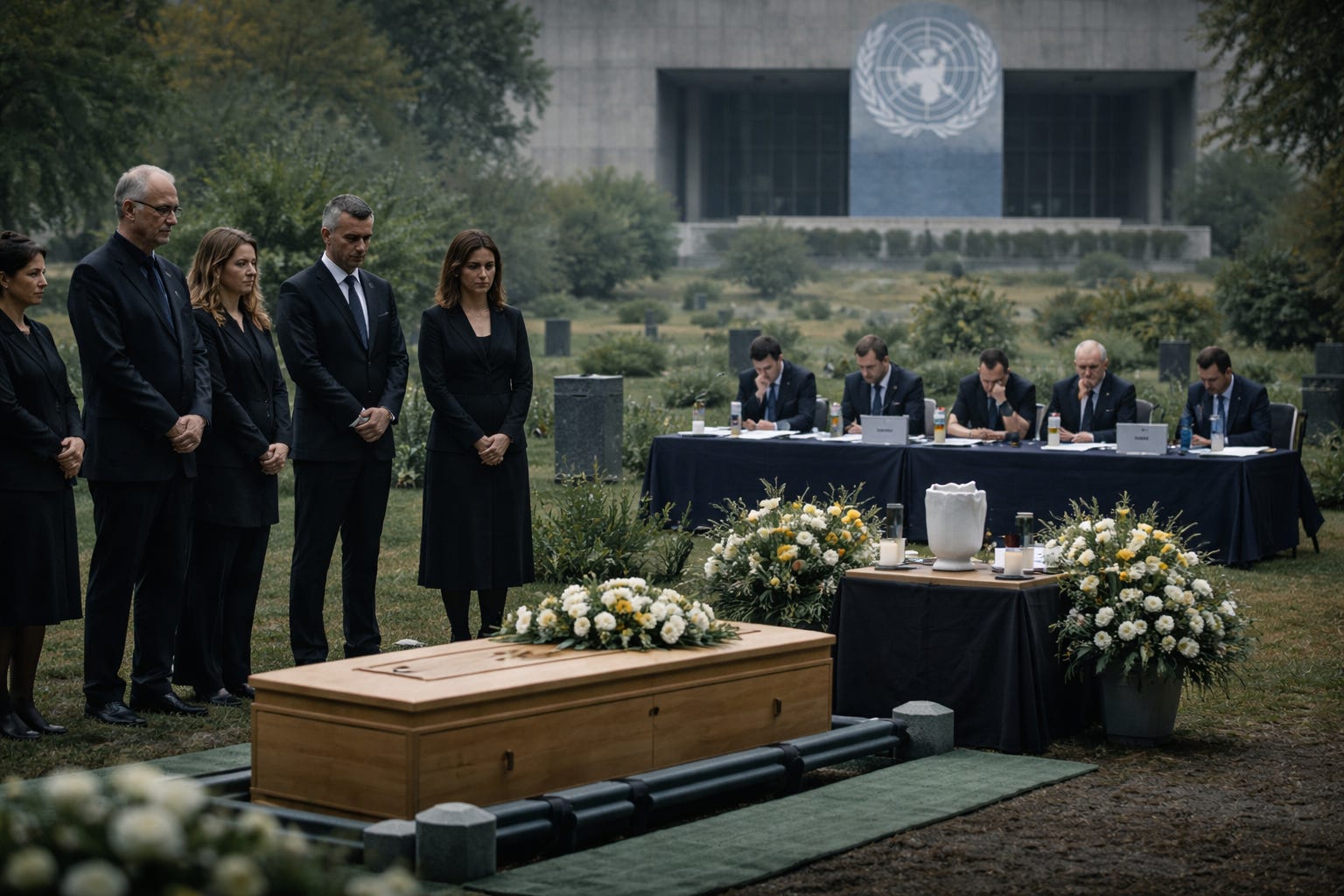
There are few moments in life more personal than death. Or more precisely: what happens right after it. Whether someone wants a quiet cremation, a secular ceremony, or absolutely no priest muttering ancient poetry over their body – these wishes matter. Non-religious funerals are not some niche lifestyle preference; they are a basic extension of personal autonomy. You’d think that would be straightforward.
Enter the United Nations, with a microphone, a committee, and – naturally – no actual power.
At the 61st session of the Human Rights Council, Humanists UK raised a legitimate issue: in many parts of the world, non-religious people struggle to have their funeral wishes respected. Sometimes it’s social pressure. Sometimes it’s family override. And sometimes, just to keep things interesting, it’s the state itself – especially in countries where leaving religion is illegal or even punishable by death.
Humanists UK did what advocacy groups do: they spoke, politely and rationally, to a UN Special Rapporteur. They highlighted real problems. They asked reasonable questions. The Rapporteur thanked them.
And that’s where the story basically ends.
Because here’s the structural reality: the UN is not a global government. It does not enforce. It does not compel. It “recommends.” Which is diplomatic language for “writes strongly worded documents that governments can safely ignore.”
In practice, the UN serves two genuinely useful functions.
First, it provides a room where the five permanent members of the Security Council – all nuclear-armed – can veto each other’s ideas instead of vaporizing each other. That’s good. Nuclear restraint via bureaucratic paralysis is still restraint.
Second, it coordinates some humanitarian aid. Also good. Food, medicine, disaster response – real, tangible impact.
Everything else? Mostly institutional theater. Panels, sessions, reports, statements. A kind of global TED Talk circuit, but with less innovation and more procedural language.
So when the UN “addresses” non-religious funeral rights, the practical effect on national governments ranges from minimal to nonexistent. Countries that already respect individual freedoms will continue doing so. Countries that criminalize apostasy are unlikely to read a UN report and think, “You know what? Let’s overhaul our legal system.”
If the goal is actual change, a UN committee is the wrong instrument. The only lever that may work is domestic: pressure on national governments in more secular democratic countries, driven by media coverage, public debate, and political cost. In such societies, that might eventually translate into policy.
The venue matters.
***
Articles 41 of 100
This piece is part of the 100 Coffees for 100 Articles campaign. Buy us a coffee and help bring our future website to life. ☕