
Trust God. Test Everyone
Why are priests being screened before Patriarch's arrival?

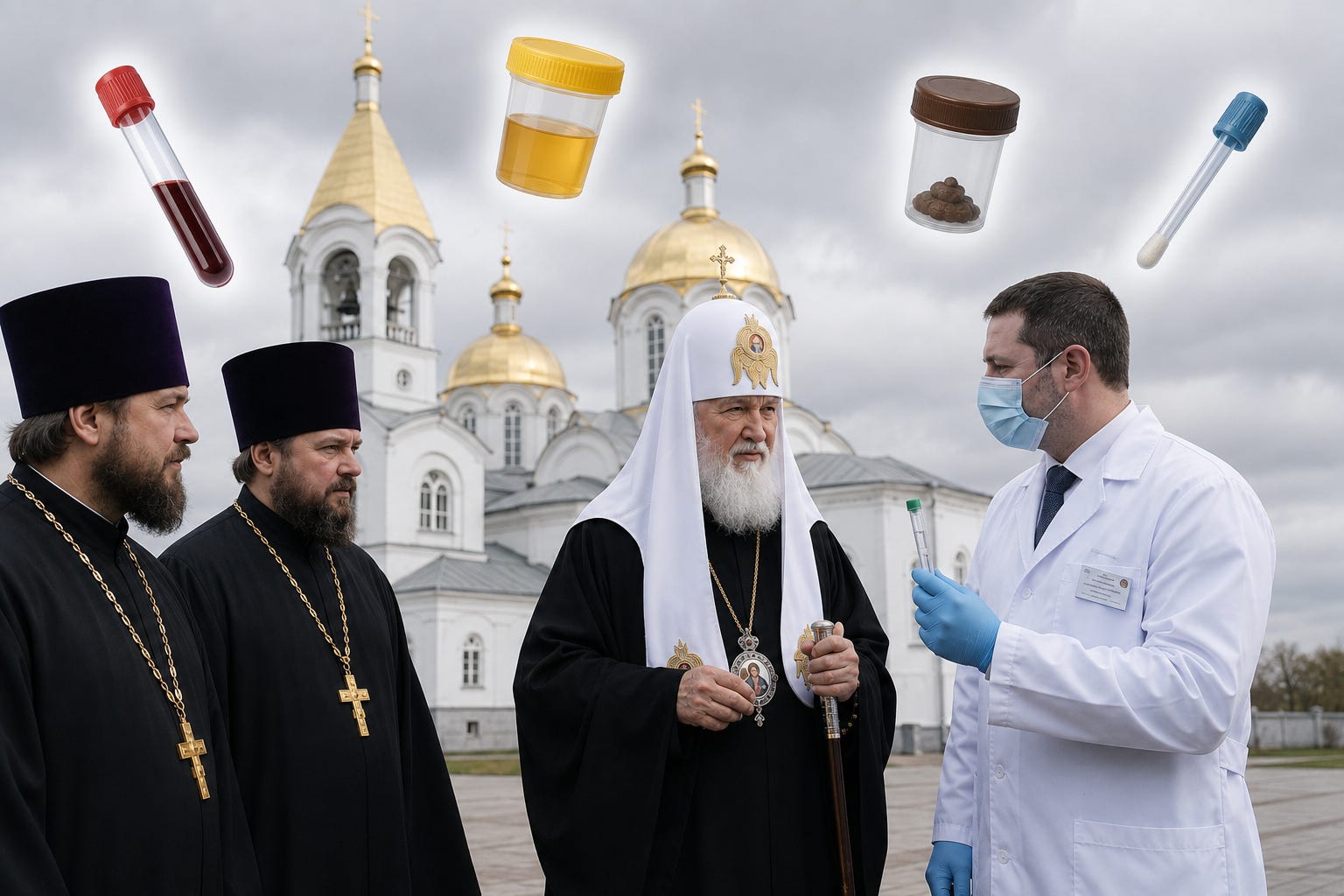
When the head of the Russian Orthodox Church, Patriarch Kirill, prepares to visit a city, one might expect prayers, blessings, and perhaps a few sermons about faith. Instead, the city of Brest, Belarus, apparently entered a state of clerical biosecurity.
According to reports, local priests who were scheduled to participate in services with Kirill on June 21 and 22 were ordered to undergo medical testing before his visit. The exact purpose of these tests has not been disclosed.
Naturally, this raises questions. Are they testing for contagious diseases? Dangerous substances? Insufficient loyalty? Independent thought? Perhaps the Church has finally discovered that exposure to reality can be hazardous to certain belief systems.
The situation is particularly amusing because the Russian Orthodox Church spends a great deal of time promoting faith, miracles, divine protection, and the power of prayer. Believers are regularly told that God watches over them, protects them, and guides their lives.
Yet when Patriarch Kirill comes to town, apparently heaven’s security department is not considered sufficient.
Instead of relying on divine protection, someone decided that laboratories, medical samples, and diagnostic procedures would be a safer bet.
One cannot help but wonder: if God protects the faithful, why the tests?
Surely a priest who spends his life serving God should be among the safest people on Earth. If anyone qualifies for supernatural healthcare coverage, it ought to be the clergy.
And yet, here we are.
Blood tests. Sample collection. Medical screening.
Not exactly the kind of measures one would expect from people who claim to have direct access to the creator of the universe.
Perhaps church officials understand something they rarely mention from the pulpit: diseases do not care about prayers, titles, vestments, or religious status. Viruses are famously indifferent to theology.
A priest can bless a building, sprinkle holy water, carry relics, recite ancient prayers, and still catch the flu.
Apparently even Patriarch Kirill’s administration understands this.
That may be the most interesting part of the story. Behind all the grand speeches about miracles and divine intervention stands an institution that, when something actually matters, quietly turns to science.
When health is on the line, the answer is not prayer. It is testing. A laboratory technician with a clipboard.
Perhaps that is the real lesson of the Brest preparations. The people who preach supernatural protection every Sunday seem remarkably eager to rely on modern medicine when it is their own safety at stake.
As it turns out, even the guardians of faith appear to trust science more than miracles.
***
👉 If this article resonates – buy us a coffee. Your support goes toward building our future website.
Article 90 of 100
This piece is part of the 100 Coffees for 100 Articles campaign. Buy us a coffee to sponsor the next one. ☕
And theology is famously indifferent to reality.
Religious claims aren't falsifiable, so science is really the only way we have of accumulating knowledge about how the world actually works. Evidently our friend the patriarch is well aware of this, but of course would never admit it as long as there's money to be made and power to be wielded over others.