
Do Atheists Even Have Feelings?
Because apparently only believers can be offended

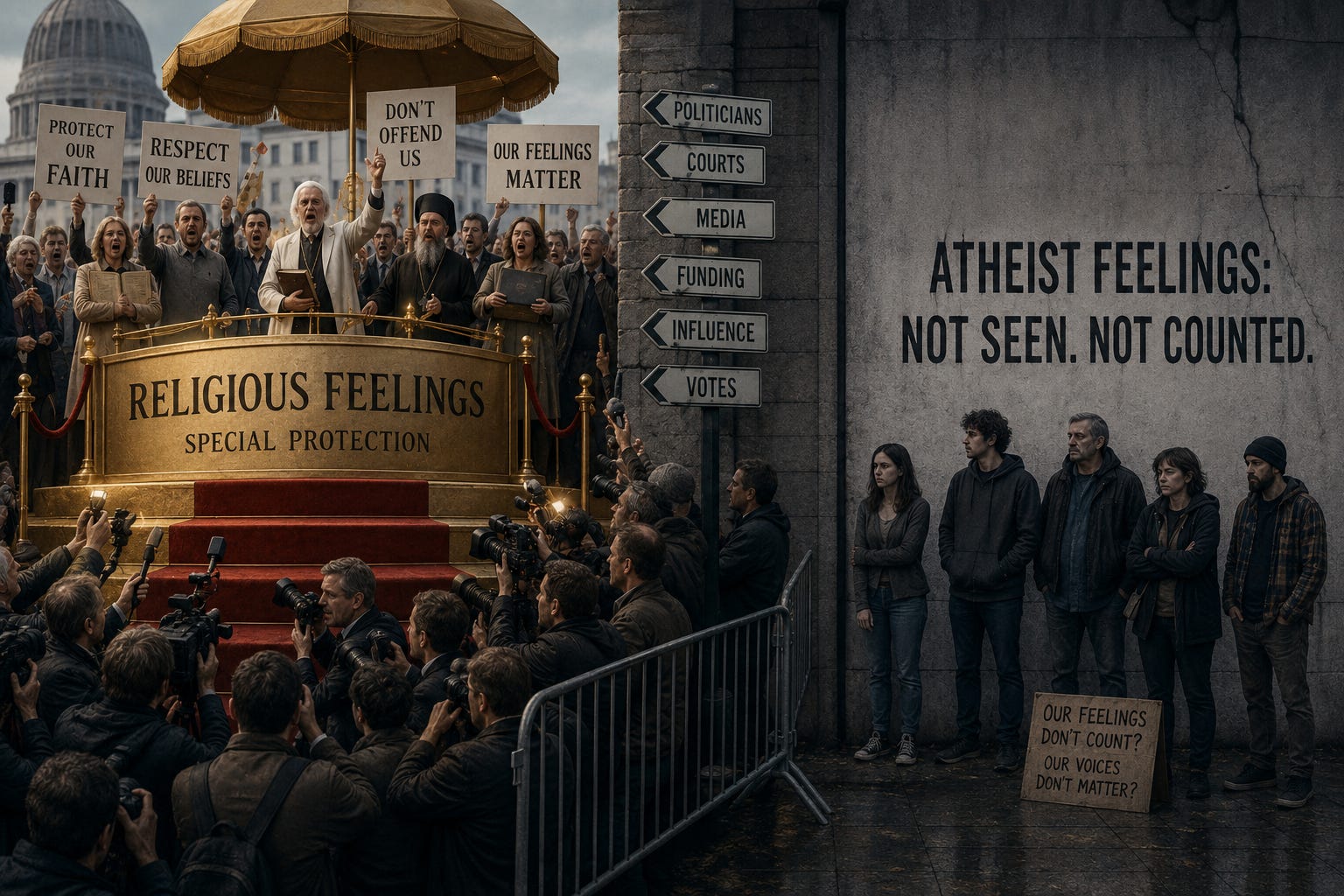
“Offending religious feelings” is one of those phrases everyone seems to understand, yet nobody can clearly define.
What exactly are religious feelings? Are they different from ordinary feelings? Are they stronger? More sacred? More fragile? Can they be measured? Do they have unique scientific properties? Nobody knows.
Yet despite this remarkable vagueness, politicians, courts, and governments routinely behave as though religious feelings are a precious national resource requiring special protection.
The concept itself is fascinating.
Religious feelings can apparently be harmed by criticism, satire, historical facts, scientific discoveries, cartoons, books, jokes, movies, or inconvenient questions. They can trigger public outrage simply because somebody disagreed with an idea.
Meanwhile, atheists are expected to quietly tolerate religious propaganda, public displays of faith, and supernatural claims presented with special respect. Whether this offends atheist feelings is a question nobody seems interested in asking.
Apparently, we do not have feelings at all. Or perhaps we do – but they don’t count.
If society insists that “religious feelings” are real and deserving of respect, then consistency demands a simple conclusion: atheist feelings are real too.
If a believer can feel offended when someone questions a sacred text, surely an atheist can feel offended when unsupported supernatural claims are promoted as fact.
If religious feelings deserve public respect, atheist feelings deserve public respect, too.
Simple enough.
Unfortunately, this is unlikely to happen anytime soon.
Why?
Because politics is a vote-counting exercise.
Religious groups are often larger, louder, wealthier, and better organized than atheist communities. Religious institutions have influence, funding, traditions, and political connections. They can mobilize supporters. They can reward politicians with votes.
Atheists, meanwhile, are frequently a minority. Many stay quiet. Many avoid public confrontation. Many simply shrug and move on.
As a result, politicians listen to the groups that can help them win elections. And those groups are rarely atheist organizations.
So the situation continues. Religious feelings receive special attention. Religious sensitivities shape public policy. Religious institutions demand respect. And atheist feelings remain invisible.
Perhaps one day governments will discover that non-believers are citizens too. But not today: there are too few of us, and we are far too quiet.
***
👉 If this article resonates – buy us a coffee.
Article 82 of 100
This piece is part of the 100 Coffees for 100 Articles campaign. Buy us a coffee to sponsor the next one. ☕
Your support goes toward building our future website.
The great John Lennon said it best with his ultimate masterpiece “Imagine.” Too bad the world needs the false opium of religion. What stupid and cowardly failures humans are. Hey assholes, you’re not going to meet your beloved dead pets, nevermind your dead friends and family.
This post really struck a nerve for me.
I've written a bunch about how the Templeton Foundation spent tons of money in academic philosophy to promote religious ideas like panpsychism while spreading false claims about science.
I place my faith in the scientific process as my method to understand the universe. And science has a good understanding of consciousness without invoking magical entities like a fundamental consciousness or universal mind.
So when people like Philip Goff lie about the failures of science and the limits of scientific inquiry, the best way to explain it is him offending my atheistic religious beliefs.
We should have respect for non-religious beliefs by not lying about them incessantly, and religious organizations funding and promoting those lies is harmful to public discourse.